|
|
|||||
|
|
|||||
|
TOMAR
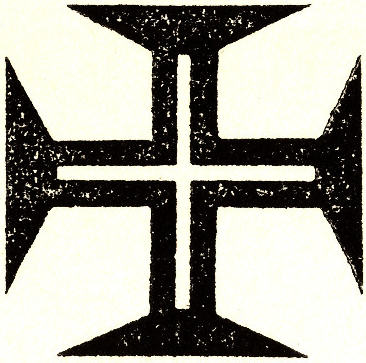
The scenery round Tomar has its peculiar character and charm, different from all the numberless and varied landscapes that extend nom North to South of Portugal. Somewhat uneven and irregular, continually washed by abundant waters of a river, owing to the springs of Agroal, where picturesque water-wheels raise the level of the waters; with luxuriant vegetation amongst which we see not only the useful olive-tree, but also the weeping-willow and sweet smelling rose-gardens. The fertility of its soil did not fail to attract the attention of the Romans who built Sellium, there, on the ruins of which, Gualdim Pais, one of the Grand Masters of the Templars, erected the stronghold that still raises high above the town which grew up under its shelter. A historical tradition – strengthened by an inscription inserted in one of the wal1s of the donjon – assures us that this important building was begun on the 1st march, 1160. Comprising four enclosures, the seat of the Knights Templars, with its polygonal chapel, was, indeed, one of the mightiest military buildings existing at the time when the fight against the Moors was fiercely raging. Fragments of old walls, having no historic interest, stand there to the present day, but this shrine of the Templars, or rather, what remains of it, is a unique monument, belonging to that graceful and vigorous transitional architecture of the twelfth century. After the suppression of the order of Templars, it continued to be the shrine of the Knights of the order of Christ, established by King Denis. A print of the sixteenth century shows us this temple, such as it was long ago, topped by an airy pyramidal dome, rising from a polygonal structure, with a window on each of its sides. One day, lightning struck the dome, destroying it; as a result of some additional works of expansion executed in the reign of King Manuel, (1495-1521) this shrine, closed till then, was connected, through a lofty arch which filled the space of two sides of this polygon of sixteen angles, into a stately nave mostly occupied by the choir; a turret and a magnificent steeple have been added since then, as well as the pictural decorations, the stuccoes, the statues, and the wood – work, which are now seen in this sanctuary of the Templars that has become, one may say, the high-altar of the church of the Convent of Christ. Notwithstanding, what remains of it is still an architectural master-piece of the twelfth century. Besides, the alterations introduced during the Renaissance period may be considered, from / 18 / an artistic point of view, perfectly remarkable. As, for instance, the mural paintings, too imperfectly repaired, and the twelve large panels in oil-colors, excellent Portuguese primitives, of which only four are to be found in their rightful places – not mentioning the two altar-pieces belonging to the side-altars, which have lately been put once more into place. In the Old Art Museum of Lisbon there are three of these panels, of which two are supposed to be by Gregório Lopes; and at the local Museum may be seen some unfinished paintings, fragmentary pieces of three others or these panels. It is a baseless invention that ascribes the other paintings to a hypothetical painter, Dralia. Let us pass now into the Churchyard Cloister, a fine, graceful specimen of the gothic style, built, like the Cloister next to it, under the rule or Henry the Navigator, by the architect Ferdinand Gonçalves, who has left his name carved there, on a stone pillar. From the works executed in the sixteenth and seventeenth centuries we have only: in the first of these cloisters a lovely arch supported on two small twin columns; in the second, which had a lower and an upper floor, the lower arch, in ruins. The old Vestry, formerly a chapel, opens into the first cloister and there, under a simple Gothic tombstone, lie the remains of the two tutors who brought up Henry the Navigator. The Manueline choir, erected against the primitive Templar's Shrine, is the most typical specimen of that Portuguese Renaissance which takes its name from King Manuel. Its outside, decorated with ornate naturalism, is nowhere more exuberant than in the west front where the well known window with its riot of symbols, is seen. (See plate n.º 9 and 10). The original design and the first works are attributed to Diogo de Arruda (the builder or Saffi, in Morocco), later on João de Castilho took control, carving his name on the wonderful figured doorway. He likewise directed the building or the unfinished Chapter House, used now as an Inscription Museum. It was this same artist who, before the year 1533, planned the vast extensions of the Convent, which became too small after the order of Christ had been reformed. In spite of the utilitarian character of these works, one may still see details worthy or the great builder. The Main Cloister, which should have been, if not finished, at least much advanced in 1558, was at this date, rebuilt in Renaissance style just as it is now. However, of his first design some fragments remain which give us an idea of its splendor: the two Refectory halls, the Chapter House, Santa Barbara's cloister, the old entrance door, the eight chapels of the lower gallery which still exist to the present day, and the outside wall on the east side of the church. / 19 / The two storied Hospital cloister is second in importance. In the Micha cloister, known before as the Labor cloister, were established the work-shops of the Convent. Under the stone slabs there is a large well whose vault is supported by six columns. Then came the cloisters of the Crows and Necessidades, both of secondary importance. Let us not forget the cloister of St. Barbara, pressed between the Main Cloister and the Hospital Cloister, which could not be raised as it would cover the famous choir-window, and whose vaults are lowered, as arches. The refectory to which the lower floor of the Main Cloister gives access is a vast roam cylindrically vaulted with two delicately sculptured pulpits. The Main Cloister, as we see it nowadays, was designed by Diogo de Torralba in 1558, but was only finished in the reign of Philip II. Its architect, the Italian Philip Terzi took a share in the work effected during the period of classic decadence. The Vestry, a vast room of baroque style, the Royal Door, (1620) as well as the entrance halls, the Infirmary and the Pharmacy of the Convent, where the famous hall of the Knights is seen, date from this period. The important aqueduct that brought water to the Convent, from a distance of six miles, was begun towards the end of the sixteenth century. When we climb down from the Convent to the town, we see, standing on a little hill, the Chapel of Our Lady of the Conception, which, in spite of that modest appellation, is an authentic jewel of the Renaissance period, perhaps one of the purest that exists in the whole Peninsula. It is, doubtless, an architectural piece of the sixteenth century. Outside, it hardly reveals the existence of the Transept and offers very little interest in its rectangular, rather heavy form. But inside, we have before our eyes a precious little Roman basilica, a rather faithful copy of the Corinthian order, with its three naves, its cylindrical vault, elegant dome and delicate tracery of its chaptels. The church of St. John the Baptist, which we see through the battlements of the Templars' old stronghold is one of the most curious of the Portuguese churches and one of the most characteristic. The date of the primitive building is unknown; we are only acquainted with the fact that about 1500 important alterations were made therein. We should say that according to all appearances, the simple gothic doorway seen in the south front must have come from the initial building, but the arches which separate the aisles are already of a later period. The principal doorway, – gothic of the later period, – and the pulpit, delicately wrought, already reveal the novelty of the Renaissance style / 20 / which slips more than once into some details, probably due to some French artists. In this church are found some noteworthy primitive paintings of the beginning of the sixteenth century, Salomé presenting the head of St. John; The Last Supper of Our Lord; Abraham and Melchisedec, the Mass of St. Gregory, etc. There, we also see the beautiful triptych of the same period, representing the Baptism of Christ (see plate n.º 14). On the opposite side of the river and dating from the time of the foundation of the Templar stronghold, stands the church of St. Maria do Olival, the primitive parish of this town. Half buried under ground, it holds our attention by its wonderful and well-kept rose-window, the archaic characteristics of its doorways, of which the principal one bears the sign of Solomon, symbol of the Templars. In the first fifty years of the sixteenth century, some important alterations were made in that church, and it was then that the tombs of the Grand-Masters of the Orders of the Templars and Christ were destroyed, though some of the inscriptions were kept. The seat of the Board of Local Initiative and Tourism has just been established there, at the corner of Rua da Graça. For this building many architectural elements of the Renaissance were used, taken from old demolished houses, such as the corner – window, which belonged in o1der times to the residence of the Prelate of the Order (See Plate nº 18).
|
|||||
|
|||||
|